Visual Impairment (VI)

What the Law Says  Eye Test


Sec. 300.8 Child with a disability.

Visual impairment including blindness means an impairment in vision that, even with correction, adversely affects a child’s educational performance. The term includes both partial sight and blindness.


What this Simply Means


Vision impairment is defined as a limitation of one or more functions of the eye (or visual system).  If your child’s visual impairment affects his/her educational performance EVEN WITH CORRECTION he/she may qualify as a student that is VI or Visually Impaired.  “Even with correction” means having had surgery or wearing glasses/contacts and vision is still impaired.

Eligibility:

Identifying students who are blind or visually impaired and establishing eligibility is the first step in meeting a student’s need. This is followed by a thorough assessment to determine the students unique visual needs and what factors assist a student’s use of vision and what factors negatively impact the student. If you think your child may qualify as a student with a Visual Impairment then contact the campus assessment specialist to start the referral process.   See the attached link for a step by step referral and testing process: http://www.teachingvisuallyimpaired.com/eligibility.html


The most common vision problems are refractive errors, more commonly known as nearsightedness, farsightedness, astigmatism and presbyopia. Refractive errors occur when the shape of the eye prevents light from focusing directly on the retina.


What are the Common Accommodations/Modifications used in the Classroom?

  • Large Print Materials i.e.: text, calculator, keyboards
  • Preferential Seating i.e.: near the speaker or board, near natural light
  • Braille
  • Supplemental Aids i.e.: magnifier, lined paper, slant board, colored overlay, lamp
  • Pass to leave class early during transitions from class to class
  • Use of elevator
  • Buddy to help student transition around the school
  • Additional desk space
  • Mobility tools i.e.: cane
  • Talking Dictionary
  • Extended Time

Farsight


Myopia


Definitions:

  1. Nearsightedness= (myopia) is a common vision condition in which you can see objects near to you clearly, but objects farther away are blurry. Nearsightedness may develop gradually or rapidly, often worsening during childhood and adolescence.
  2. Farsightedness=  (hyperopia) is a common vision condition in which you can see distant objects clearly, but objects nearby may be blurry. The degree of your farsightedness influences your focusing ability.
  3. Astigmatism=  a defect in the eye or in a lens caused by a deviation from spherical curvature, which results in distorted images, as light rays are prevented from meeting at a common focus.
  4. Presbyopia=  farsightedness caused by loss of elasticity of the lens of the eye, occurring typically in middle and old age.

References:

  1.  http://idea.ed.gov/explore/view/p/,root,regs,300,A,300%252E8,
  2. http://www.ridbc.org.au/blindness

Speech Impairment

What the Law Says  Communication


Sec. 300.8 Child with a disability.

Speech or language impairment means a communication disorder, such as stuttering, impaired articulation, a language impairment, or a voice impairment, that adversely affects a child’s educational performance.


What this Simply Means


Speech and language impairments typically emerge at a young age.  The earlier a child is diagnosed and receives services (either privately or through the school),  the more likely that child can outgrow the disability. Speech-language pathologists work with children with speech and language impairments, as well as with parents and teachers.  If a child fails to meet the speech and language developmental milestones set by American Speech-Language-Hearing Association (ASHA), he or she might have a speech and language impairment.

Typically a parent is the first to suspect their child has a speech delay.  If  a delay  is suspected, the first step is to talk to your child’s primary care physician.  Provide examples of concerns based on developmental milestones.  See attached chart for language and speech developmental milestones:  http://firstyears.org/miles/chart.htm

Components of a Diagnostic Evaluation of Speech-Language Impairment

If your child is recommended for an evaluation, you will be referred to a Speech-Language Pathologist (SLP) for testing. There are several goals in a diagnostic assessment, including verifying that a speech-language impairment exists, describing the strengths and weaknesses of the child’s speech and language, evaluating the severity of the problem (mild, moderate, severe, or profound), ascertaining the etiology (how or why the impairment occurred), determining recommendations for a treatment plan, and providing a prognosis.  Assessment requires obtaining a sample of communication skills across settings through a number of procedures. This means a SLP cannot give one test and make a diagnosis. It is critical to collect information not only from standardized formal tools but also from authentic, real-life information in order to facilitate meaningful and accurate decisions.  Case history information, parent interviews, checklists from other providers such as the primary care physician, observations in the home or school, hearing screening to rule out possible hearing loss, and examination of the speech mechanism are included (lips, tongue, palate, facial structure) as parts of the evaluation.  Formal norm-referenced tests are used to assess articulation, phonology, grammatical understanding and production, and pragmatic language use. The collection of data from the authentic assessment tools and the formal measures provide a comprehensive picture of the speech-language needs of a young child with a communication impairment.

If your child is diagnosed with a speech impairment then a treatment plan will be created based on the areas in which he/she has challenges.  The variety of impairments in speech and language require different intervention approaches that can address deficits in language form (syntax, phonology, morphology), language content (semantics), and language use (pragmatics) as well as speech and voice production. Further, intervention for young children may involve not just the speech-language pathologist but also parents, teachers, and additional individuals that have contact with the child.  The ultimate goal of intervention is to increase a child’s success in using language to communicate.


Definitions:

  1.  Syntax=  the arrangement of words and phrases to create well-formed sentences in a language.
  2. Phonology=  the study of the distribution and patterning of speech sounds in a language and of the rules governing pronunciation.
  3. Morphology=  the study of the internal structure of words.
  4. Semantics=  the meaning of a word, phrase, sentence, or text.
  5. Pragmatics=  dealing with things sensibly and realistically in a way that is based on practical.
  6. Speech= the expression of or the ability to express thoughts and feelings by articulate sounds.
  7. Language=  the method of human communication, either spoken or written, consisting of the use of words in a structured and conventional way.

References:

  1.  http://idea.ed.gov/explore/view/p/,root,regs,300,A,300%252E8,
  2. http://www.specialeducationguide.com/disability-profiles/speech-and-language-impairments/
  3. http://www.asha.org/uploadedFiles/ASHA/Publications/leader/2013/130801/DSM-5-Chart.pdf (pages 2-3)
  4. http://www.theravive.com/therapedia/Language-Disorder-DSM–5-315.39-(F80.9)
  5. http://www.theravive.com/therapedia/Speech-Sound-Disorder-(Phonological-Disorder)-DSM–5-315.39-(F80.0)

IEP Meeting Deliberations

Pen and paper

The IEP meeting minutes are the written notes summarizing the decisions and decision-making process of the IEP team and IEP team meeting. It is important to note that IDEIA 2004 does not reference meeting minutes, meeting notes, deliberation notes, or deliberations summaries. Thus, rules and regulations about IEP minutes do not exist.  There are some states where IEP minutes are not even taken so please check your state rules to become aware if it is something the school requires/considers. Keep in mind, if the IEP team DOES write notes summarizing the meeting or decisions made within the meeting, the notes become an official part of your child’s record. Rules regarding confidential records would apply.

The purpose of the minutes, or deliberations, is to record what happened at the meeting.  It is like a diary.  In the district I work in; the special education staff i.e.: Educational diagnostician or special education, teacher takes the minutes.   If the meeting is not recorded then the minutes will serve as the official record of the discussion and decisions.


Guidelines to meeting deliberations:

1.  Minutes do not have to be verbatim transcript of the discussion of the meeting but merely a summary.

2.  Minutes are the work product of the school district; this is the school district’s record of the meeting.  If you as the parent do not approve of the minutes then you may take your own and ask the committee to add your summary to the IEP paperwork as an addendum.  http://www.specialeducationadvisor.com/iep-meeting-minutes/ 

3.  Minutes are not dictated by any one person at the meeting, whether that is the parent, the school administrator, an advocate or another individual.

4.  Minutes accurately capture the discussion of the meeting- they are not one sided.  Parent input must be added to the minutes. If you as the parent have questions or information you feel needs to be documented in the minutes then request that it is added to the summary.

5.  Minutes are read to all participants at the IEP meeting before they are finalized.  Incorporate suggestions by all individuals.  By this I mean; before I read the IEP minutes I always say to the committee (which includes the parent), “As I read the minutes please stop me at any time if you would like for me to clarify a sentence, adjust, delete, or add to this summary.”


References:

1.  http://www.texasprojectfirst.org/ARDIEP.html

2.  http://ritter.tea.state.tx.us/rules/tac/ch089aa.html

Assistive Technology

What the Law says


Sec. 300.5 Assistive technology device.

Assistive technology device means any item, piece of equipment, or product system, whether acquired commercially off the shelf, modified, or customized, that is used to increase, maintain, or improve the functional capabilities of a child with a disability. The term does not include a medical device that is surgically implanted, or the replacement of such device.


What this Simply means


Although IDEA (the law) uses the term “device,” it is important to recognize that assistive technology devices required by students with disabilities include hardware and software as well as stand-alone devices. Almost any tool can be considered to be an assistive technology device except for those assistive technology devices that are surgically implanted (cochlear implant) and have been excluded from the definition of an assistive technology device as defined in IDEA.

There are three different types of Assistive technology: low, mid, and high.

Low:  Low tech AT are devices or equipment that don’t require much training, may be less expensive and do not have complex or mechanical features.  Examples of Low tech AT are:

  • specialized pen or pencil grips
  • large print text
  • handheld magnifiers
  • seat cushions
  • slant boards

Mid: Mid tech AT devices or equipment that falls in the middle of the continuum may have some complex features, may be electronic or battery operated, may require some training to learn how to use and are more expensive than the low-tech devices.  Examples of Mid tech AT are:

  • talking spell checkers
  • books on CD
  • Simplified Voice Out-put device (“Big Mack,” “Voice in the Box,” “Cheap 4 Talk,” tape recorder or recordable device)

High:  High Tech AT refers to the most complex devices or equipment. These devices may have digital or electronic components, may be computerized, will likely require training and effort to learn how to use and cost the most.  Examples of High tech AT are:

  • Voice Output System (DynaVox)
  • Alternate mouse or keyboard for the computer (large print keyboard for visual impairment children)
  • Any type of special software such as; “OnScreen Keyboards” which are software-generated images of a standard or modified keyboard placed on the computer screen. The keys are selected by a mouse, touch screen, trackball, joystick, switch, or electronic pointing device or “Screen Reader” which is a software program that uses synthesized speech to “speak” graphics and text aloud. This type of program is used by people with limited vision or blindness or with a print disability, such as dyslexia.
  • Hearing aids IF the district provides it to the student


How do you get Assistive Technology (services) for your child?

After discussing a student’s present level of performance and developing the measurable annual goals, the IEP committee would describe how the student’s disability affects ability to participate in the classroom. If the ARDC believes the student requires any of the previously mentioned technology to access instruction or participate in the classroom in the areas of support for instruction (academic/function skills), visual difficulties/impairment, mobility/positioning/physical access, communication and cognition, then assistive technology is considered.

Based on the need, a referral for an AT evaluation will be made, consent will be given by you the parent, and an evaluation will take place.  The evaluation will determine if assistive technology is recommended. Those recommendations will be presented at an ARDC meeting, and the ARDC will make the final decision regarding the necessity of AT for your student.


Assistive Technology Act of 2004

“One of the major changes brought about by the Assistive Technology Act of 2004 was a change in purpose. Previous Acts focused on helping states build “systems for improving access to assistive technology devices for individuals with disabilities.”[3] With the 2004 edition, the Act now required States to provide direct aid to individuals with disabilities to ensure they have access to the technology they need. As a result, the majority of State efforts are required to be conducted in the following areas: assistive technology reutilization programs, assistive technology demonstration programs, alternative financing programs and device loan programs.”


Please enjoy the video.  Even though the identifying information is for individuals that live in Oklahoma we think the information is great and can apply to any state!


References:

1.  http://www.specialed.us/autism/assist/asst14.htm

2.  http://idea.ed.gov/explore/view/p/,root,regs,300,A,300%252E5,

3.  http://www.assistivetechnology.vcu.edu/files/mt/2/AT_Continuum_Generic10_06.pdf


Autism

autism ribbon

The criteria for Autism depends on who defines the condition—-the state, the federal government, or the medical community.   Today’s discussion focuses on the Texas Education Agency eligibility criteria, Federal Regulation criteria, and the DSM-V criteria.

What the Law says


§89.1040. Eligibility Criteria. Texas Education Agency (TEA)

(1)  Autism. A student with autism is one who has been determined to meet the criteria for autism as stated in 34 CFR, §300.8(c)(1). Students with pervasive developmental disorders are included under this category. The team’s written report of evaluation must include specific recommendations for behavioral interventions and strategies.

§300.8   Child with a disability. Federal Definition/Criteria (IDEA)

(1)(i) Autism means a developmental disability significantly affecting verbal and nonverbal communication and social interaction, generally evident before age three, that adversely affects a child’s educational performance. Other characteristics often associated with autism are engagement in repetitive activities and stereotyped movements, resistance to environmental change or change in daily routines, and unusual responses to sensory experiences.

(ii) Autism does not apply if a child’s educational performance is adversely affected primarily because the child has an emotional disturbance, as defined in paragraph (c)(4) of this section.

(iii) A child who manifests the characteristics of autism after age three could be identified as having autism if the criteria in paragraph (c)(1)(i) of this section are satisfied.


DSM-V:  The American Psychiatric Association’s Diagnostic and Statistical Manual, Fifth Edition (DSM-5)  provides standardized criteria to help diagnose ASD.  DSM-V

Diagnostic Criteria for 299.00 Autism Spectrum Disorder

  1. Persistent deficits in social communication and social interaction across multiple contexts, as manifested by the following, currently or by history (examples are illustrative, not exhaustive; see text):
    1. Deficits in social-emotional reciprocity, ranging, for example, from abnormal social approach and failure of normal back-and-forth conversation; to reduced sharing of interests, emotions, or affect; to failure to initiate or respond to social interactions.
    2. Deficits in nonverbal communicative behaviors used for social interaction, ranging, for example, from poorly integrated verbal and nonverbal communication; to abnormalities in eye contact and body language or deficits in understanding and use of gestures; to a total lack of facial expressions and nonverbal communication.
    3. Deficits in developing, maintaining, and understand relationships, ranging, for example, from difficulties adjusting behavior to suit various social contexts; to difficulties in sharing imaginative play or in making friends; to absence of interest in peers.

Specify current severity:

Severity is based on social communication impairments and restricted, repetitive patterns of behavior.

  1. Restricted, repetitive patterns of behavior, interests, or activities, as manifested by at least two of the following, currently or by history (examples are illustrative, not exhaustive; see text):
    1. Stereotyped or repetitive motor movements, use of objects, or speech (e.g., simple motor stereotypes, lining up toys or flipping objects, echolalia, idiosyncratic phrases).
    2. Insistence on sameness, inflexible adherence to routines, or ritualized patterns of verbal or nonverbal behavior (e.g., extreme distress at small changes, difficulties with transitions, rigid thinking patterns, greeting rituals, need to take same route or eat same food every day).
    3. Highly restricted, fixated interests that are abnormal in intensity or focus (e.g., strong attachment to or preoccupation with unusual objects, excessively circumscribed or perseverative interests).
    4. Hyper- or hyporeactivity to sensory input or unusual interest in sensory aspects of the environment (e.g. apparent indifference to pain/temperature, adverse response to specific sounds or textures, excessive smelling or touching of objects, visual fascination with lights or movement).

Specify current severity:

Severity is based on social communication impairments and restricted, repetitive patterns of behavior.

  1. Symptoms must be present in the early developmental period (but may not become fully manifest until social demands exceed limited capacities, or may be masked by learned strategies in later life).
  2. Symptoms cause clinically significant impairment in social, occupational, or other important areas of current functioning.
  3. These disturbances are not better explained by intellectual disability (intellectual developmental disorder) or global developmental delay. Intellectual disability and autism spectrum disorder frequently co-occur; to make comorbid diagnoses of autism spectrum disorder and intellectual disability, social communication should be beloiw that expected for general developmental level.

Note: Individuals with a well-established DSM-IV diagnosis of autistic disorder, Asperger’s disorder, or pervasive developmental disorder not otherwise specified should be given the diagnosis of autism spectrum disorder. Individuals who have marked deficits in social communication, but whose symptoms do not otherwise meet criteria for autism spectrum disorder, should be evaluated for social (pragmatic) communication disorder.

Specify if:

With or without accompanying intellectual impairment

With or without accompanying language impairment

Associated with a known medical or genetic condition or environmental factor

(Coding note: Use additional code to identify the associated medical or genetic condition.)

Associated with another neurodevelopmental, mental, or behavioral disorder

(Coding note: Use additional code[s] to identify the associated neurodevelopmental, mental, or behavioral disorder[s].

With catatonia (refer to the criteria for catatonia associated with another mental disorder)

(Coding note: Use additional code 293.89 catatonia associated with autism spectrum disorder to indicate the presence of the comorbid catatonia.)


What this Simply means


So what does this mean?…….  Your child may or may not qualify as a person with Autism depending on who administers the evaluation.   I have a co-worker whose child was labeled with Aspergers/OCD/Sensory Processing Disorder using the DSM-V in a medical setting.  However, when her child was tested in the school setting for additional services,  he did not qualify with an Autism eligibility.  When I chose to have my own son tested 8 years ago, my husband and I picked a medical setting for the determination of the condition. We went to Texas Children’s Hospital. At that time, we were on a 7 month waiting list, but we didn’t mind because he was getting private therapy to address his needs.  The evaluator and /or location for the assessment is a personal choice.

What do the definitions have in common?

  • Demonstration of  the signs of autism by an early age.
  • Identification of autism after the age of three if the child  shows characteristics of autism i.e.: repetitive activities and stereotyped movements, resistance to environmental change or change in daily routines, unusual responses to sensory experiences, verbal and nonverbal language delay, limited social skills
  • Persistent (continuing to exist or endure over a prolonged period) deficits in social interaction and social situations: either with children or adults
  • Persistent deficits in social communication: nonverbal and verbal
  • Repetitive motor movements
  • Ritualized patterns of behavior (insists on sameness i.e: all cans must face the same way, blocks must be in a particular line), autism stacking objectsattachment to a certain routine, and increased frustration at change in routine/schedule 
  • Fixated interest for objects or situations to the point of obsession
  • Hyper-activity or hypo re-activity to sensory input

There are more commonalities between the definitions than differences. If you are considering a service plan for your child that will utilize school, state and federal resources then it is important to make sure your child is identified across entities. Then you can ensure assistance from all viable sources.

http://www.youtube.com/watch?v=UK3RdcKQiHQ

Resources:

1.  http://www.ecfr.gov/cgi-bin/text-idx?c=ecfr&sid=a8493b2e1c8d7bb90fca3eef0c28b3eb&rgn=div8&view=text&node=34:2.1.1.1.1.1.36.7&idno=34

2.  http://idea.ed.gov/explore/view/p/,root,regs,300,A,300%252E8,

3.  http://www.cdc.gov/ncbddd/autism/hcp-dsm.html

4.  https://www.autismspeaks.org/what-autism/diagnosis/dsm-5-diagnostic-criteria

The Role of the High School Case Manager

In the life of any student, high school can be extremely frustrating. High school is the juncture in one’s school career in which responsibility is expected. It is necessary for students to manage time, classes, personalities, friendships, hormones, parents, extra-curricular activities, jobs, etc., without the cushion of “being just a kid.”

For students with disabilities, these pressures can be exacerbated by concurrent learning, social and/or emotional problems. To top it all off, everything counts. Credits and GPA points began accumulating in high school and they set the stage for life after graduation.

To assist students with disabilities, case managers are assigned. These persons are the designated “experts” for all issues concerning the student. Case managers build relationships, monitor progress, propose goals/objectives, contact parents, tutor and provide other services as needed to help facilitate student success. Their most important duty is help ensure the services documented in the student’s IEP are being provided.

The case manager role is vital; for this reason many case managers of students with disabilities receive additional compensation. Below are several steps to take as a parent to make sure you and your student are receiving optimal benefit from the case management process:

• Find out if your school utilizes the case management process.
• Make contact with your child’s case manager and establish progress update parameters if contact is needed more than regular progress reporting.
• Sign up for computer access to your student’s records. This will give you a great starting point for questions/concerns.
• Request that the initial IEP dissemination and any subsequent changes be sent to you when the IEP goes out to teachers.
• Encourage your child to establish frequent contact with his/her case manager regarding any concerns.
• Request a copy of tutorial times for each of your child’s teachers.

These steps will hopefully put you and your child on the right path to be successful in the high school setting.

Intellectual Disability (ID)

What the law says


IDEA’s Definition of “Intellectual Disability”

Our nation’s special education law, the IDEA, defines intellectual disability as . . .

“. . . significantly subaverage general intellectual functioning, existing concurrently with deficits in adaptive behavior and manifested during the developmental period, that adversely affects a child’s educational performance.” [34 Code of Federal Regulations §300.7(c)(6)]

On October 5, 2010, President Obama signed legislation requiring the federal government to replace the term “mental retardation” with “intellectual disability” in many areas of government. This measure, known as Rosa’s Law, strips the terms “mental retardation” and “mentally retarded” from federal health, education, and labor policy. “Intellectual disability” or “individual with an intellectual disability” are being inserted in place of these outdated terms. The rights of individuals with disabilities remain the same.


What this Simply means


Individuals with an intellectual disability may have  deficits in mental functioning, communication, adaptive behavior, and social skills.

Intellectual disabilities are diagnosed by looking at two main things. These are:

  • the ability of a person’s brain to learn, think, solve problems, and make sense of the world (called IQ or intellectual functioning); and
  • whether the person has the skills he or she needs to live independently (called adaptive behavior, or adaptive functioning).

Intellectual functioning, or IQ, is usually measured by Intelligence tests or Cognitive ability tests (more commonly referred to as IQ tests).  The average score for these types of tests is 100. People scoring below the 70-75 range are considered to have an intellectual ability if they also have deficits in adaptive behavior. To measure adaptive behavior, professionals look at what a child can do in comparison to other children of his or her age. Skills which comprise most adaptive behavior assessments include:

  • daily living skills, such as getting dressed, going to the bathroom, and feeding one’s self;
  • communication skills, such as understanding what is said and being able to answer;
  • social skills with peers, family members, adults, and others.

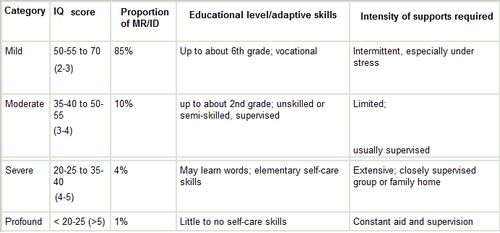
To diagnose an intellectual disability, professionals look at the person’s mental abilities (IQ) and his or her adaptive skills.  The diagnosis of ID requires an intelligence deficit of at least 2 standard deviations (SDs) below the mean IQ. Equivalent deficits in at least 2 areas of functional life skills or adaptive skills also must be present to meet the diagnostic criteria for ID. Adaptive skills encompass functional life skills within the domains of communication, self-care, home living, social and interpersonal skills, use of community resources, self-direction, functional academic skills, work, leisure, health, and safety.

What does it mean if my child is identified as Intellectually Disabled?

It means you do the same thing you would do for a non-disabled child–start preparing the child for independence. No child is the same, so preparation will entail:

  • determining present levels of functioning and immediate needs
  • creating a plan for the child’s future
  • registering for agency supports early if you think you or the child will need assistance
  • creating an atmosphere that focuses and builds on the child’s strengths
  • accepting the child’s differences are not necessarily weaknesses
  • planning for instruction that goes across settings: school, home,  community
  • exposing the child to as many experiences as possible

Early preparation and planning is critical.


http://medchrome.com/wp-content/uploads/2011/07/mental-retardation-table.jpg


Social Security Statement:  We are replacing the term “mental retardation” with “intellectual disability” in our Listing of Impairments (listings) that we use to evaluate claims involving mental disorders in adults and children under titles II and XVI of the Social Security Act (Act) and in other appropriate sections of our rules. This change reflects the widespread adoption of the term “intellectual disability” by Congress, government agencies, and various public and private organizations.

References:

1.  https://www.federalregister.gov/articles/2013/08/01/2013-18552/change-in-terminology-mental-retardation-to-intellectual-disability

2.  http://eclkc.ohs.acf.hhs.gov/hslc/tta-system/teaching/Disabilities/services%20to%20children%20with%20disabilities/disabilities/disabl_fts_00014_061105.html

3.  http://idea.ed.gov/explore/view/p/,root,regs,300,A,300%252E8,

Gift Ideas for Children with Special Needs

Buying a toy, gift, or Christmas present for a child or teen on the autism spectrum can be challenging.   Over the years I have kept a list of gifts purchased by my husband and I as well as family members for my son.  Listed below are some great gift ideas along with links to the purchase site.  I hope you enjoy and find it very useful!  Happy Holidays!

Joki Swing

Joki Swing  $89.00-119.00


http://www.autism-products.com/ProductDetails.asp?ProductCode=1353862&utm_source=Shopzilla&utm_medium=feed&utm_campaign=Comparison%20Shopping

PeaPod


Pea Pod  $79.00-$89.00


http://www.autism-products.com/ProductDetails.asp?ProductCode=1325197


Parachute


Parachute  $11.00-$60.00 depending on size


http://www.amazon.com/s/?ie=UTF8&keywords=play+parachutes&tag=googhydr-20&index=aps&hvadid=26871347829&hvpos=1t1&hvexid=&hvnetw=g&hvrand=11282731674389520253&hvpone=&hvptwo=&hvqmt=b&hvdev=c&ref=pd_sl_37ghiu05yk_b


Strider

Strider  $85.00-$245.00 depending on size


http://www.autism-products.com/SearchResults.asp?Search=strider&Submit=Search

Tramp


Fold and Go Trampoline  $96.00


http://www.autism-products.com/SearchResults.asp?Search=fold+and+go+trampoline&Submit=Search

Vibrat neck pillow


Vibrating devices Vobro TactileAround $20.00 and can be found at any CVS, Wal-Mart, or Wal-Greens


Fidgets

Fidgets $5.00 and up depending on where you buy and how many


Weighted Blanket

Weighted Blanket $60-$200 depending on the size and site you buy from


http://www.themagicblanket.net/index.html


My son also loves to take horse riding and swim lessons (which can be around $30-$60 per session). Monetary gifts are also great because they can be applied to therapy sessions or other recreational activities.

Of course there are several items out there that can work for your child or family member but hopefully this post will give you some ideas and point you in the right direction.  The resources below are great and I encourage you to take a look.

Merry Christmas!


Resources:

1.  http://www.nationalautismresources.com/toys-for-autism.html

2.  http://www.autism-products.com/default.asp

3.  amazon.com


Other Health Impairment (OHI)

What the Law says


Sec. 300.8 Child with a disability.

(9) Other health impairment means having limited strength, vitality, or alertness, including a heightened alertness to environmental stimuli, that results in limited alertness with respect to the educational environment, that–

  (i) Is due to chronic or acute health problems such as asthma, attention deficit disorder or attention deficit hyperactivity disorder, diabetes, epilepsy, a heart condition, hemophilia, lead poisoning, leukemia, nephritis, rheumatic fever, sickle cell anemia, and Tourette syndrome; and

  (ii) Adversely affects a child’s educational performance.

What that Simply means


In order to obtain the label/eligibility of Other Health Impairment (OHI), the student’s academic performance must be effected by limitations in the three areas of strength, vitality, and alertness.  OHI, like all other qualifying conditions, must create a need for special education services. Generally speaking, analysis of OHI eligibility first considers the child’s health condition and its general effects on the child, then looks separately at the disability’s effect on the child’s educational performance.  A child who suffers from one of the conditions listed in the federal or state regulations listed above may be considered OHI. The list is not, however, exhaustive. Moreover, being diagnosed as suffering from one of these conditions does not automatically qualify a child as OHI eligible. The disabling condition must be chronic or acute and must result in limited strength, vitality, or alertness to the educational environment. Whether a particular student is classified as OHI will depend on the way the condition affects his or her alertness or responsiveness to the educational environment.  Classification, therefore, must be determined on a case-by case basis.

Three leading classifications under Other Health Impairment include epilepsy, asthma, and diabetes but that may not always be the case.  After collecting data from several school districts, doctors, publications, and education agency websites, the subcategory of attention-deficit/hyperactivity disorder (AD/HD) is most often used as a deciding factor to receive the eligibility of OHI.  This condition naturally lends itself to the OHI classification in that it is characterized by an inability to focus, which usually contributes to decreased alertness to the educational environment.

**A child with limited alertness whose educational performance is not affected does not qualify for placement as OHI.

Frequently asked questions by parents:

Q.  My child has asthma.  Can he qualify as OHI?

A.  If your child never experienced asthma attacks at school, is passing all classes, and has no attendance problems he will not qualify as OHI. There are no signs of limited alertness, strength, or vitality. (1)


Q.  My child has Chronic fatigue syndrome and has difficulty getting up in the morning and staying alert throughout the day. He often misses school because of these symptoms and his low energy levels.

A.  If your child’s educational performance if effected then, yes, your child can qualify as a student with OHI.  If fact, there is case law that has established legal presidence in California specifically for Chronic fatigue syndrome. (2)


Q.  My child has diabetes.  Can he qualify as OHI?

A.  Remember that every child is different.  Does you child miss a lot of school?  Are grades suffering from symptoms of diabetes?  Does your child have chronic inattentiveness?  If you answered yes…..then your child could qualify as OHI.  BUT   If your child has only occasional inattentiveness, only misses class to take his medication and check his blood sugar levels, and is passing all classes……..then your child would not qualify as OHI. (3)

Q.  My child has been identified by his doctor as having ADHD but with prescribed medication he is doing fine in school.  Should I seek out an OHI eligibility?

A.  If your child is passing classes and is having no problems in the school setting; I would not seek out the eligibility.


Reference:

American Psychiatric Association (2013).

Diagnostic and statistical manual of mental disorders (DSM-5), Washington, D.C.: American Psychiatric Association

http://ritter.tea.state.tx.us/rules/tac/chapter089/ch089aa.html

ADHD Symptoms and Diagnosis

Home


Case law:

1.  Jefferson County Bd. of Educ., 29 IDELR 690 (SEA Ala. 1998).

2.  Bret Harte Union High Sch. Dist., 30 IDELR 1014 (SEA Cal. 1999).

3.  Lisbon Sch. Dept., 33 IDELR 172 (SEA Me. 2000).


Videos:

Your Special Education Rights by: Jennifer Laviano and Julie Swanson

YSERVIDEOS

Emotional Disturbance

According to IDEA the Emotional Disturbance eligibility is described as following:

A condition exhibiting one or more of the following characteristics over a long period of time and to a marked degree that adversely affects a child’s educational performance:

(A) An inability to learn that cannot be explained by intellectual, sensory, or health factors.

(B) An inability to build or maintain satisfactory interpersonal relationships with peers and teachers.

(C) Inappropriate types of behavior or feelings under normal circumstances.

(D) A general pervasive mood of unhappiness or depression.

(E) A tendency to develop physical symptoms or fears associated with personal or school problems.

The term includes schizophrenia. The term does not apply to children who are socially maladjusted, unless it is determined that they have an emotional disturbance” (CFR §300.7 (a) 9)

It will take several blogs to foster a clear understanding of Emotional Disturbance.  For the purposes of this blog, we will look at the eligibility and its differences from social mal-adjustment because they are often confused or misunderstood.

The greatest hindrance to understanding Emotional Disturbance is the view that this eligibility excuses students from the consequences for inappropriate behavior. This has caused the need to clearly differentiate between a “true” emotional disturbance and social mal-adjustment.  The general consensus in the world of education is that the two mutually exclusive; however legally and diagnostically, things are not always as clear cut.

We have already given the IDEA definition of Emotional Disturbance. What then is Social Maladjustment?  Terms that may be more familiar are Oppositional Defiant Disorder or Conduct Disorder. Students with social mal-adjustment typically display a persistent pattern of willful refusal to meet even minimum standards of conduct. Their behavior and values are often in conflict with society’s standards. They exhibit a consistent pattern of antisocial behavior without genuine signs of guilt, remorse, or concern for the feelings of others. These students often engage in simulations of these behaviors but typically display them only when there is an immediate consequence for the absence of such displays. Their antisocial behavior is most frequently seen as resulting from their tendency to place their own needs above those of all other people and the immediate gratification that such behavior brings them. These students are not in chronic distress (one of the criteria for emotional disturbance under the law) although they can exhibit situational anxiety, depression, or distress in response to certain isolated events – particularly facing the consequences of their own actions. These students do not typically respond to the same treatment interventions that benefit emotionally disordered students.

I interviewed several school psychologists on the difference between the two. I was referred to the following chart which provides delineation.

Behavior Area Emotional Disturbance Socially Maladjusted
School Behavior Unable to comply with teacher requests; needy or has difficulty asking for help Unwilling to comply with teacher requests; truancy; rejects help
Attitude Toward School School is a source of confusion or angst; does much better with structure Dislikes school, except as a social outlet; rebels against rules and structure
School Attendance Misses school due to emotional or psychosomatic issues Misses school due to choice
Educational Performance Uneven achievement; impaired by anxiety, depression, or emotions Achievement influenced by truancy, negative attitude toward school, avoidance
Peer Relations/ Friendships Difficulty making friends; ignored or rejected Accepted by a same delinquent or socio-cultural subgroup
Perceptions of Peers Perceived as bizarre or odd; often ridiculed Perceived as cool, tough, charismatic
Social Skills Poorly developed; immature; difficulty reading social cues; difficulty entering groups Well developed; well attuned to social cues
Interpersonal Relations Inability to establish or maintain relationships; withdrawn; social anxiety Many relations within select peer group; manipulative; lack of honesty in relationships
Interpersonal Dynamics Poor self-concept; overly dependent; anxious; fearful; mood swings; distorts reality Inflated self-concept; independent; underdeveloped conscience; blames others; excessive bravado
Locus of Disorder Affective disorder; internalizing Conduct disorder, externalizing
Aggression Hurts self and others as an end Hurts others as a means to an end
Anxiety Tense; fearful Appears relaxed; cool
Affective Reactions Disproportionate reactions, but not under student’s control Intentional with features of anger and rage; explosive
Conscience Remorseful; self-critical; overly serious Little remorse; blaming; non-empathetic
Sense of Reality Fantasy; naïve; gullible; thought disorders Street-wise; manipulates facts and rules for own benefit
Developmental Immature; regressive Age appropriate or above
Risk Taking Avoids risks; resists making choices Risk taker; daredevil
Substance Abuse Less likely; may use individually More likely; peer involvement


The bottom line for parents is more and more children are faced with both disorders. In the school setting, the student labeled as emotionally disturbed has a much better chance to access special education services and supports.  It is critical, however, whatever the condition, that parents seek early intervention for the child.